
By Sabahat Ali – Link building expert since 2009 – 668+ clients served
KEY STATISTICS
- Chicago therapy practice: 3,103% organic user growth [YourPortal Marketing]
- Therapist achieved 10x website traffic through SEO [Koppla Marketing]
- 327% organic traffic + top 3 for 70+ mental health keywords [Direction.com]
- Most therapists see SEO results within 3-6 months [iCANotes, 2026]
- 80% of webmasters who respond to outreach demand payment [Our data, 100K+ emails]
People searching online for answers and local businesses—including social media platforms—has become the norm. It only makes sense to make your therapy practice visible where your future clients are looking.
Most people seeking a therapist begin with a Google search. According to BrightLocal, 74% of users check online platforms to review local businesses before visiting. Furthermore, Market.us reports that over 60% of people search for health-related information online.
If your practice does not appear on search engine results pages (SERPs), potential clients will likely book with a competitor. Ranking well signals credibility, positions your practice as an authority, and reduces reliance on referrals.
How search engines shape how clients find you
What is SEO for Therapists?
Search Engine Optimization (SEO) for therapists is the strategic process of improving a private practice’s website to rank higher in search results. By optimizing for high-intent keywords like “anxiety therapist near me” and building local authority, therapists can attract qualified clients directly from Google without relying solely on paid ads or directories.
People rarely go past the first page of Google. A study from Reputation911 shows that over 90% of users never click beyond page one.

Source: Reputation911
To rank on the first page, your website must demonstrate trust, relevance, and user experience. For therapists, this requires:
- Relevance: Your content must match specific needs and locations (e.g., “anxiety therapist in Chicago”).
- Authority: Trusted websites should link back to you, signaling credibility to Google.
To improve visibility immediately:
- Research client-focused local keywords (e.g., “therapist near me”).
- Write content answering common questions (e.g., “How to find a therapist in [location]”).
- Earn quality backlinks to establish your practice as a trusted resource.
How to build a strong SEO strategy as a therapist
A robust online presence relies on two pillars: a clear technical SEO foundation and a strong local SEO strategy. These work together to ensure you are visible to both search algorithms and local clients.
Define clear goals for your SEO strategy
Outline exactly what you want your SEO efforts to achieve. Common goals for private practices include:
- Increasing direct client inquiries through the website.
- Ranking for specific service keywords (e.g., “couples counseling,” “trauma therapy”).
- Competing locally against other established private practices.
Research competitors and keywords
Analyze other therapists in your area to identify service gaps. Use SEO tools to uncover high-intent keywords such as:
- “Therapist in [City]”
- “Online therapy for anxiety”
- “Affordable counseling near me”
The keyword research process using Ahrefs:
- Go to Ahrefs Site Explorer.
- Insert your website URL and click search.
- Select “Organic Competitors” to see who you are up against.
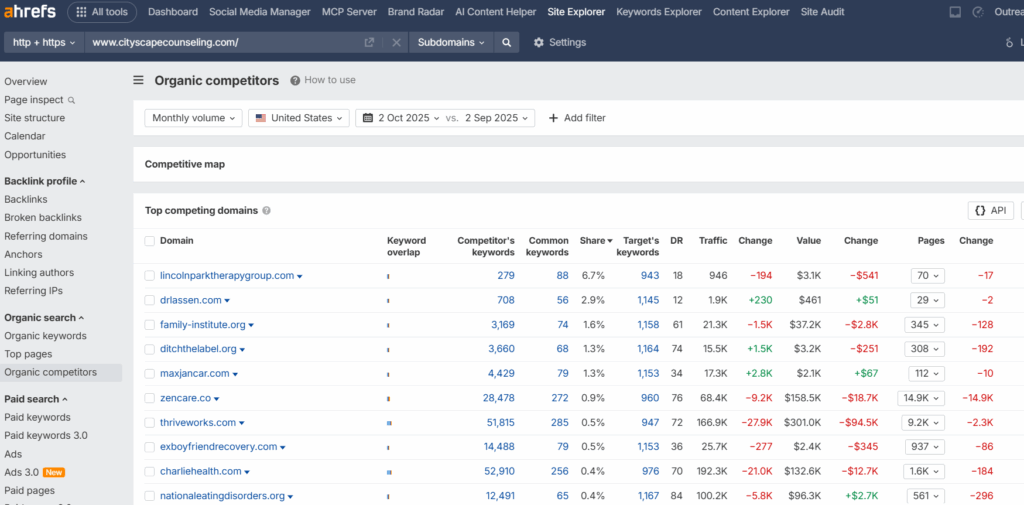
Pro tip: Manually verify competitors by visiting their URLs to ensure they are local private practices, not large directories.
Once you identify a competitor:
- Paste their URL into Site Explorer.
- Click on “Organic Keywords.”
- Filter by position 1-10 to see their top-performing terms.
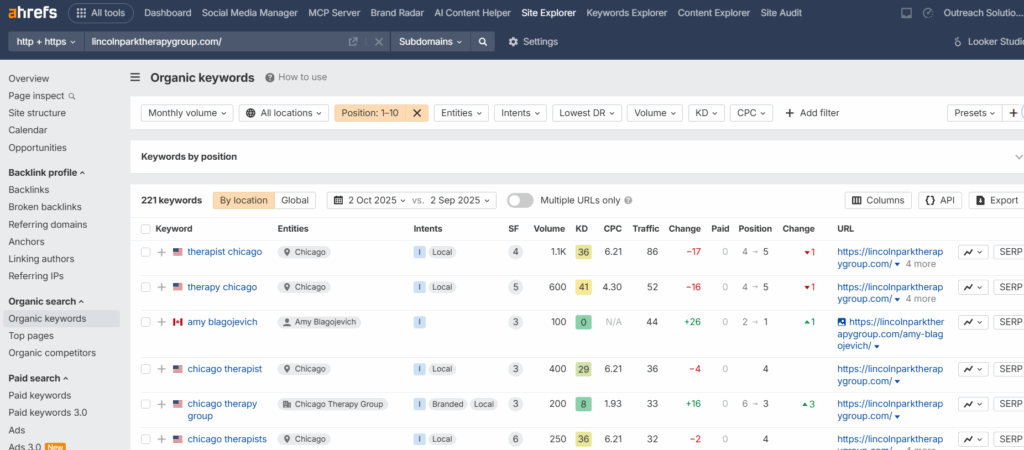
Target keywords where you currently lack visibility but where search volume indicates potential leads.
Optimize your website for local SEO
Local visibility is critical for in-person practices. To capture nearby clients:
- Claim your Google Business Profile (GBP): Ensure your Name, Address, and Phone number (NAP) are consistent across the web.
- Verify your location: Complete the verification process to appear in Google Maps.
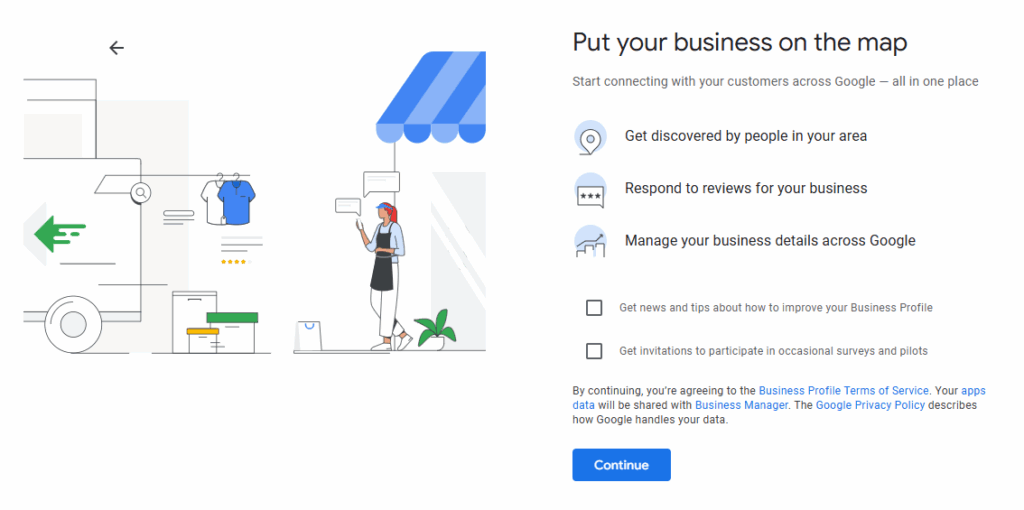
Read more on optimizing your GBP here.
- Use geo-modifiers: Include city or neighborhood names in headings, title tags, and meta descriptions.
- Encourage reviews: Verified positive reviews signal local credibility.
Build authority with local citations and partnerships
Citations are mentions of your practice on other sites. List your services on reputable directories like Psychology Today and Healthgrades. Additionally, partner with local health organizations for guest posts to earn valuable backlinks that reinforce your location relevance.
Make relevant content that serves both SEO and local needs
Your content must bridge the gap between search intent and local needs. For example, a blog post titled “How to Find a Therapist in Chicago” targets a specific location while educating the user, helping you rank for both the topic and the city.
Create high-quality content
Quality content builds trust before a client contacts you. To demonstrate expertise:
- Answer direct questions: Address concerns like “How do I know if I need therapy?” with direct answers.
- Prioritize clarity: Avoid jargon. Explain processes and tips in a structured, accessible way.
- Diversify formats: Use FAQs, infographics, and consented case studies to engage different learning styles.
Pro tip: Turn the top 5 questions clients ask during consultations into dedicated blog posts.
On-page SEO for therapists
On-page SEO converts visitors into booked sessions by making your site clear and persuasive.
Optimize titles, headers, and meta descriptions
Headers and titles should be client-friendly and keyword-rich.
Example:
Title: Anxiety Therapist in Chicago – Compassionate Counseling
Meta Description: Licensed Chicago therapist specializing in anxiety and depression. Schedule your first session today.
Structure your service pages
Create a dedicated URL for each service to avoid confusion. Structure these pages for scanability:
- Use clear, descriptive headings.
- Keep paragraphs short and concise.
- Utilize bullet points for symptoms or benefits.
Use calls-to-action (CTAs) on every page
Guide visitors clearly on the next step. High-performing CTAs include:
- “Schedule a free 15-minute consultation.”
- “Book your first online session.”
- “Contact us to learn more.”
Support with trust signals
According to ReviewTrackers, reviews are a top factor in local search decision-making. prominently display your bios, state licenses, and client testimonials to build immediate credibility.
Earning high-quality backlinks from other websites
Backlinks function as votes of confidence. A link from a respected health website carries significantly more weight than multiple links from unrelated blogs. Focus on quality over quantity and avoid spammy link schemes.
Strategies to earn backlinks:
- Guest posting: Submit articles to wellness or local community blogs.
- Professional directories: Ensure you are listed on trusted health sites.
- Partnerships: Collaborate with universities or nonprofits on resources.
- HARO (Help a Reporter Out): Provide expert quotes to journalists for media mentions.
Copy-Paste Outreach Script for Guest Posting
Subject: Contribution idea for [Site Name] readers: Mental Health Tips
Hi [Name],
I’ve been reading [Site Name] and love your recent piece on [Topic].
I am a licensed therapist specializing in [Specialty]. I’d love to contribute a high-quality article for your audience on “[Proposed Title]”. It would cover actionable tips on [Brief Point 1] and [Brief Point 2].
Let me know if you’re open to a draft!
Best,
[Your Name]
Aim to secure 3–5 high-quality backlinks every quarter to build steady authority.
Mobile optimization for therapists’ websites
In 2025, mobile devices account for over 60% of all web traffic (Statista). If your site takes longer than 3 seconds to load, you risk losing clients in moments of need.
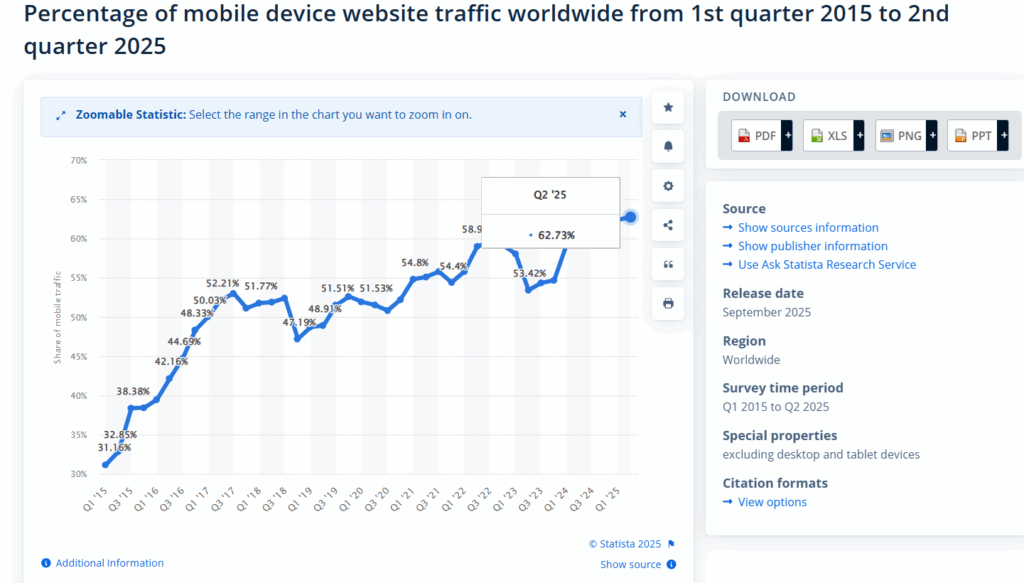
Source: Statista
Key mobile optimizations:
- Responsive design: Ensure the site adapts to all screen sizes.
- Speed: Compress images and use reliable hosting.
- Click-to-call: Allow users to dial your number with one tap.
- Simple forms: Keep booking forms short and easy to type on touchscreens.
- Readability: Use ample spacing and distinct headings.
Tracking and measuring SEO efforts with Google Analytics
To ensure your budget is well-spent, you must track performance. Google Analytics and Search Console provide the data needed to refine your strategy.
Key metrics to track:
- Organic traffic: The number of visitors coming from search engines.
- Top pages: Identify which services attract the most interest.
- Bounce rate: Determine if users leave your site too quickly.
- Conversions: Track contact form fills, calls, and bookings.
Review these metrics monthly. If traffic is high but conversions are low, revisit your CTAs and page clarity.
Case Study: 6-Month SEO Growth Timeline
Here is what a successful SEO implementation looks like for a private practice:
| Phase | Focus Area | Outcome |
|---|---|---|
| Month 1 | Technical Audit & GBP Setup | Website is crawlable; Practice appears on Maps. |
| Month 2-3 | Service Page Optimization | Individual services begin ranking for long-tail keywords. |
| Month 4-5 | Content & Link Building | Domain authority increases; traffic stabilizes. |
| Month 6 | Review & Scale | Consistent lead flow; reduced reliance on referrals. |
Real Results: Therapist SEO Case Studies
Best Therapies (Chicago) — 3,103% Organic User Growth: This Chicago-based therapy practice experienced a 3,103% spike in organic users and 2,670% growth in new visitors. Direct traffic grew 973% showing stronger brand recognition, and bounce rate from organic decreased by 26.2% [YourPortal Marketing, 2025].
Therapist — 10x Website Traffic: A single therapist increased website traffic by 10x through consistent content creation targeting local mental health search terms and building backlinks from healthcare directories [Koppla Marketing, 2025].
Therapy Practice — 327% Organic Traffic + Top 3 for 70+ Keywords: A mental health practice achieved 327% organic traffic growth and earned top 3 rankings for over 70 keywords, connecting them with local audiences actively searching for mental health services [Direction.com, 2025].
Psychologist — 1,600+ Keywords in 24 Months: After a 24-month SEO campaign, a psychologist now ranks for over 1,600 keywords including competitive terms like “eating disorder psychologist” and “therapist near me” [Tom Bostrom, 2025].
Ready to invest in professional SEO services
Managing SEO while running a practice is challenging. Agencies like SERPReach specialize in link building and local SEO to handle the technical heavy lifting. We help you:
- Conduct deep competitor research.
- Build high-quality backlinks from reputable sites.
- Optimize technical performance and mobile speed.
- Execute a long-term strategy tailored to your growth.
Strong SEO is a profitable investment that provides a steady stream of new clients. Consistency is key—choose a strategy that works and stick with it.
For more, see our pricing guide and beginner checklist.
Disclosure
SERPreach provides niche edit and guest posting services for mental health practices.
References
- iCANotes. (2026). SEO for Therapists Guide. icanotes.com
- YourPortal Marketing. (2025). Best Therapies SEO Case Study. yourportalonline.com
- Koppla Marketing. (2025). Therapist 10x Traffic Case Study. kopplamarketing.com
- Direction.com. (2025). Mental Health SEO Services. direction.com
- Tom Bostrom. (2025). SEO for Psychologists. tombostrom.com

