
By Sabahat Ali – Link building expert since 2009 – 668+ clients served
KEY STATISTICS
- Pest control company: 167% organic traffic growth in 12 months [Stigan Media]
- 4x daily visitors in 90 days without any paid ads [SharedGraphics]
- 185% traffic growth + 65% reduction in ad spend from local SEO [D&D SEO]
- 46% of Google searches have local intent [BrightLocal, 2025]
- 80% of webmasters who respond to outreach demand payment [Our data, 100K+ emails]
While word-of-mouth referrals are valuable, they lack the scalability required for aggressive growth. To dominate your local market, you must implement a robust strategy for SEO for pest control and link building for pest control. These digital pillars transform your website from a digital brochure into a lead-generation engine.
Search Engine Optimization (SEO) increases your visibility for high-intent searches, while link building establishes the E-E-A-T (Experience, Expertise, Authoritativeness, and Trustworthiness) necessary to outrank established competitors. Follow this eight-step framework to scale your pest control business through organic search.
Looking for a shortcut to dominate the SERPs? You can accelerate your rankings by acquiring high-authority niche edits and guest post links from relevant industry sites.
Step 1: Understanding search intent in the pest control industry
What is SEO for pest control?
Pest control SEO is the strategic process of optimizing your website to rank for industry-specific keywords like “pest control near me” or “termite inspection.” It involves technical optimization, local SEO, and building pest control backlinks to improve visibility, build authority, and generate consistent high-quality leads.
Successful pest control seo starts with understanding user intent. You must align your content with exactly what the user is searching for to reduce bounce rates and increase conversions.
Identify the main types of search intent
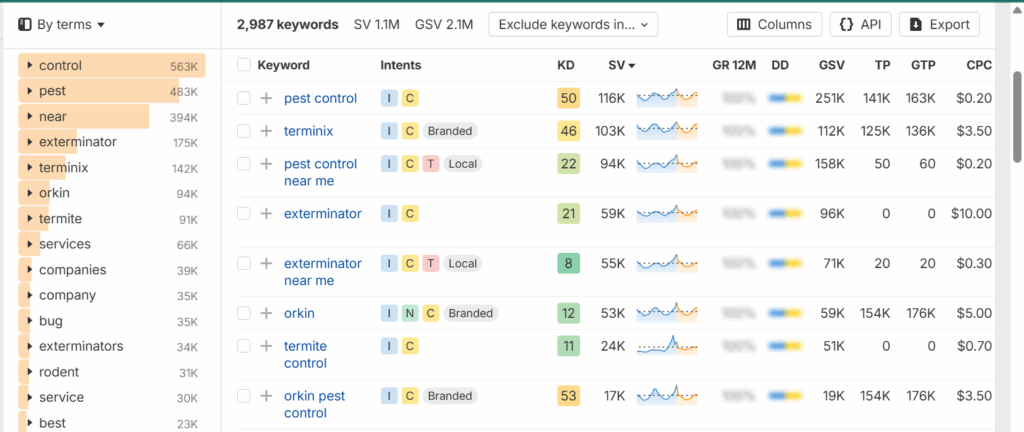
Use tools like Ahrefs or Google Keyword Planner to analyze your core services. Categorize your findings into three buckets:
- Informational: Users seeking education (e.g., “how to identify bed bug bites”).
- Transactional: Users ready to hire (e.g., “emergency pest control services”).
- Navigational: Users looking for a specific brand (e.g., “Orkin login”).
Analyze search results to confirm intent
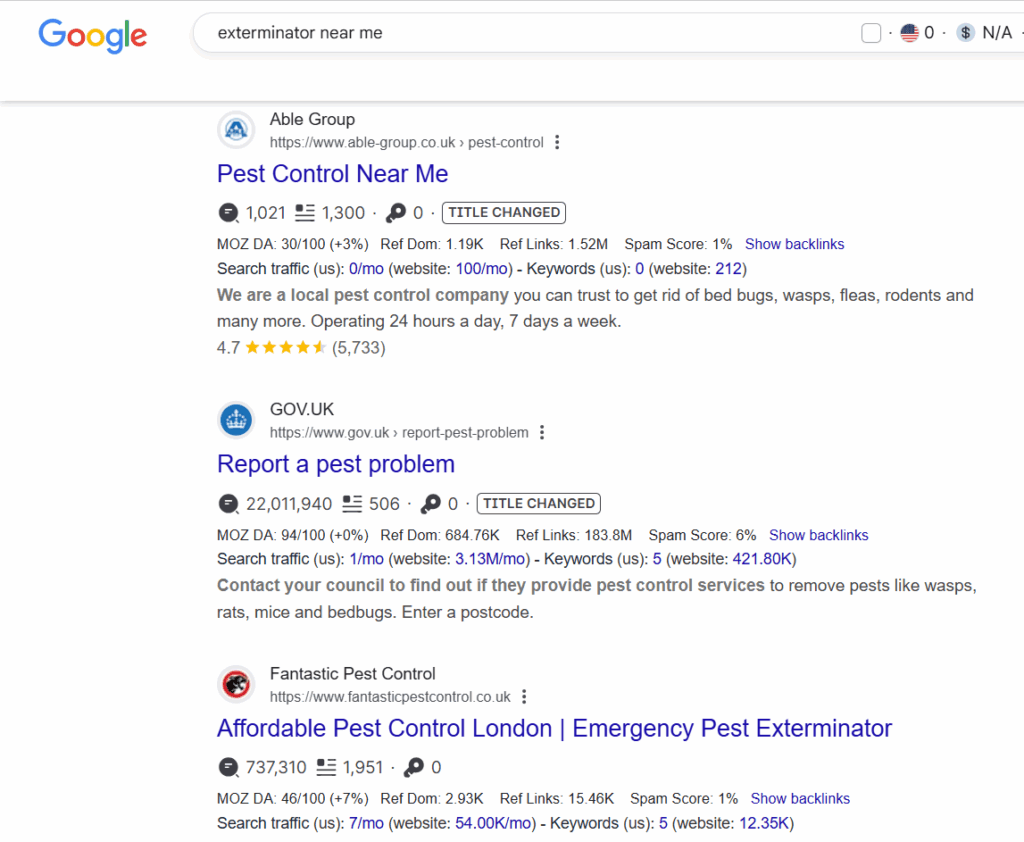
Perform a manual Google search for your target keywords. The current top-ranking results dictate the expected content type:
- Blog Posts/Guides: Signifies informational intent. Focus on “how-to” content.
- Service Pages: Signifies transactional intent. Focus on pricing, features, and CTAs.
Create content that matches intent
Map your keywords to specific page types to ensure high engagement:
- Informational: Long-form guides that build authority and capture top-of-funnel traffic.
- Transactional: Conversion-optimized service pages designed to capture “ready-to-buy” leads.
Step 2: Keyword research for pest control companies
Effective pest control link building and content strategy rely on a data-driven keyword list. Focus on a mix of high-volume national terms and high-conversion local terms.
Start with industry-focused keyword tools
Generate a baseline list using the following workflow:
- Enter “termite inspection,” “rodent control,” and “exterminator” into Google Keyword Planner.
- Export these to Ahrefs to filter by Keyword Difficulty (KD) and Search Volume.

Build a local keyword list for targeted traffic
Local keywords are your primary revenue drivers. Optimize for:
- Geo-modified terms: “[Service] + [City]” (e.g., “cockroach removal Houston”).
- “Near me” queries: Google automatically localizes these based on user IP.
Balance national reach with local conversions
Maintain a diversified portfolio of 5–10 high-volume national keywords for brand awareness and 15–20 localized keywords for immediate lead generation. Ensure each keyword is mapped to a unique URL to prevent keyword cannibalization.
Step 3: Creating and optimizing service pages for pest control SEO
Your service pages are your “money pages.” They must be technically sound and psychologically persuasive.
Follow a proven structure to boost conversions
- H1: Include the primary service and location.
- Social Proof: Display certifications (NPMA) and immediate trust signals.
- Clear CTA: Use high-contrast buttons for “Book Inspection” or “Call Now.”
Incorporate pest control keywords naturally
Avoid keyword stuffing. Place your primary keyword in the H1, the first 100 words, and within at least one H2. Use LSI (Latent Semantic Indexing) keywords like “infestation,” “treatment plan,” and “safety” to provide context to search engines.
Build trust with proof and guarantees
- Before-and-after photos: Visual proof of efficacy.
- Verified Reviews: Embed Google or Yelp reviews directly.
- Guarantees: Offer a “no-return guarantee” to lower the barrier to entry.
Strengthen SEO with internal linking
Connect your service pages to relevant blog content. For example, a page on “Spider Control” should link to a blog post about “Identifying Common House Spiders.” This distributes “link juice” and keeps users on-site longer.
Step 4: Local SEO strategies for pest control companies
Comparison of Local Authority Signals
| Strategy | SEO Impact | Effort Level |
|---|---|---|
| Google Business Profile | Critical (Map Pack) | Low (Weekly Updates) |
| Local Citations (Yelp/Angi) | High (Trust/Consistency) | Medium (One-time Setup) |
| Pest Control Backlinks | Extreme (Ranking Power) | High (Ongoing) |
Fully optimize your Google Business Profile for visibility
Your GBP is the engine of the “Map Pack.” Ensure your business category is set correctly to “Pest Control Service.” Upload weekly photos of your branded trucks and technicians to signal active operations to Google.
Keep your NAP details consistent everywhere
NAP (Name, Address, Phone) consistency is a major local ranking factor. Use an identical format on your website footer, GBP, and all directories. Inconsistency signals lack of reliability to search algorithms.
Build local citations through industry and community links
- Join the local Chamber of Commerce.
- Secure listings on niche-specific directories like https://www.google.com/search?q=PestControlSearch.com.
Actively collect and respond to reviews
Quantity, velocity, and diversity of reviews impact rankings. Automate review requests via SMS immediately after service completion.
Real Results: Pest Control SEO Case Studies
167% Organic Traffic Increase: A pest control company achieved 167% organic traffic growth in one year through technical SEO fixes, on-page content optimization, and a strong local SEO strategy [Stigan Media, 2025].
4x Daily Visitors in 90 Days — No Ads: A Southern California pest control company went from 70 to 280+ daily organic visitors in 90 days. They achieved top 3 rankings without spending the $3,000-$5,000/month that competitors pay for Google Ads [SharedGraphics, 2026].
Pestend — 26% Traffic + 54% More Conversions: Since 2013, Pestend has grown organic traffic by 26% and conversions by 54% through local SEO, technical optimization, and high-quality locally relevant backlinks from partnerships and shareable content [Homevu, 2025].
185% Traffic Growth + 65% Less Ad Spend: A 90-day local SEO campaign delivered 185% organic traffic growth, 3-4 inbound calls per day, 3,100+ monthly profile views, and a 65% reduction in paid search spending [D&D SEO, 2025].
Step 5: Mobile optimization for pest control websites
Know why mobile optimization improves your local SEO rankings
Most pest control emergencies are searched for on mobile. Google uses mobile-first indexing, meaning your mobile site’s performance determines your desktop rankings.
Speed up your mobile site to keep visitors from leaving
- Image Compression: Use WebP format for high-res images.
- CDN: Use Cloudflare or similar to serve content from the nearest server.
Make calling you easy with mobile-friendly features
Implement a “Sticky Header” with a prominent “Click-to-Call” button. Ensure forms are easy to fill with “Fat Finger” friendly buttons and minimal fields.
Test and refine for a smooth mobile experience
Regularly use the Google Search Console “Page Experience” report to identify Core Web Vital issues that could be throttling your traffic.
Step 6: Content marketing ideas for the pest control industry
Blog ideas for attracting organic traffic
Target “Problem/Solution” keywords: “How to tell if you have termites,” or “Are wasps dangerous to pets?” This positions your brand as an expert before the user even needs to hire a professional.
Create visuals like pest identification charts
Infographics and identification charts are “linkable assets.” High-quality visuals earn pest control backlinks naturally when other home-improvement blogs reference your data.
Write FAQs to target featured snippets
Answer “People Also Ask” questions directly. Use a Q&A format: Question (H3): How much does termite treatment cost? Answer (Paragraph): A direct 40-50 word answer stating average price ranges and factors involved.
Step 7: Link building for pest control companies
Case Study: Local Authority Surge
Problem: A Phoenix-based exterminator was stuck on page 2 for “termite control.”
Solution: We secured 5 pest control backlinks from regional home-improvement blogs and updated their GBP with 20 geo-tagged photos.
Result: Moved to #2 in the Map Pack within 45 days, resulting in a 34% increase in inbound calls.
Why backlinks matter for pest control SEO
Backlinks are the most weighted ranking factor. High-authority pest control link building proves to Google that your site is a legitimate resource within the home services niche.
Get links from suppliers, partners, and local businesses
Leverage existing relationships. Ask your equipment suppliers (e.g., Target Specialty Products) for a partner link. Cross-link with local landscaping or HVAC companies to build a local “referral web.”
Interactive Asset: Outreach Script
Subject: Helping [Website Name] readers with pest prevention
Hi [Name], I’m [Your Name] from [Your Company]. I noticed your recent post on summer home maintenance. I’ve put together a specific 5-step checklist for preventing [Local Pest] that your readers might find useful. Would you be open to a guest contribution or adding a tip from a certified pro? Cheers!
Avoid low-quality link building tactics
Avoid Fiverr “SEO packages” or generic PBN links. Focus on relevance. A link from a local “Moms of [City]” blog is worth more than 100 links from unrelated overseas directories.
Step 8: Tracking your pest control SEO services performance
Use SEO tools to track rankings, traffic, and backlinks
Monitor your “Money Keywords” in Search Console. If you see an increase in “Impressions” but not “Clicks,” your Meta Titles need better optimization.
Set and review SEO goals regularly
Don’t just track rankings; track conversions. Use UTM parameters on your GBP website link to see exactly how many leads come from the Map Pack vs. organic listings.
Adjust strategies based on performance data
If a specific service page isn’t ranking, it likely needs more pest control backlinks or more comprehensive content. SEO is an iterative process—measure, adjust, and scale.
Ready to dominate the search results? Start with these eight steps to build a sustainable lead-generation machine. If you’re ready to accelerate your growth, consider partnering with a specialized pest control seo company to handle the heavy lifting of technical optimization and link acquisition.
For more, see our pricing guide, HVAC link building, and beginner checklist.
Disclosure
SERPreach provides niche edit and guest posting services for pest control businesses.
References
- BrightLocal. (2025). Local Consumer Review Survey. brightlocal.com
- Stigan Media. (2025). Pest Control SEO: 167% Traffic Increase. stiganmedia.com
- SharedGraphics. (2026). Pest Control SEO: 3x Traffic in 90 Days. sharedgraphics.com
- Homevu. (2025). Pestend SEO Case Study. homevu.com
- D&D SEO Services. (2025). Pest Control Local SEO Case Study. dndseoservices.com

