
By Sabahat Ali – Link building expert since 2009 – 668+ clients served
KEY STATISTICS
- Wedding photographer earned $42,000 extra revenue from SEO [Brendan Hufford]
- 10x organic traffic growth for wedding photographer through content + backlinks [Wedding Maps]
- 46% of Google searches have local intent — critical for wedding photographers [BrightLocal, 2025]
- 80% of webmasters who respond to outreach demand payment [Our data, 100K+ emails]
Uploading to Pinterest is a start, but it isn’t a complete SEO strategy. While social platforms offer quick engagement, they rarely drive the long-term, high-intent traffic that a well-optimized website provides. This guide covers the full spectrum of SEO for wedding photographers, moving beyond simple galleries to build a site that outranks competitors and converts visitors into clients.
Key Takeaway: High-end imagery must be supported by strategic technical optimization. Mastering both ensures your wedding photography services reach couples at the exact moment they are ready to book.
What you’ll learn:
- Identifying high-intent keywords that couples actually search for.
- On-page SEO tactics to improve portfolio visibility.
- Image optimization secrets to dominate Google Images.
- Link building for wedding photographers to establish industry authority.
- Local SEO frameworks to dominate your specific geographic market.
Need quality wedding photographer backlinks without the manual outreach grind? We offer niche edits and guest post links to accelerate your path to page one.
SEO for wedding photographers: Refresher
SEO for wedding photographers is the process of optimizing your website’s content, structure, and authority to rank higher in search results. By targeting terms like “wedding photographer near me” and building wedding photographer backlinks, you signal to Google that your site is the most relevant and trustworthy option for engaged couples.
Effective SEO is divided into two pillars: On-page (what happens on your site) and Link Building (what happens off your site). While SEO provides the visibility, wedding photographer link building establishes the reputation required to sustain high rankings.
Despite the rise of AI search, the fundamentals of EE-A-T (Experience, Expertise, Authoritativeness, and Trustworthiness) remain the core of ranking. As ChatGPT and other AI tools increasingly rely on Google’s index, being the primary source of quality content is more important than ever.

SEO Strategy Comparison
| Strategy | Primary Focus | Primary Benefit |
|---|---|---|
| On-Page SEO | Keywords & Content | Direct relevance for specific search queries. |
| Local SEO | Google Business Profile | Dominance in local “Map Pack” results. |
| Link Building | Backlinks & Authority | Long-term ranking stability and trust. |
Find relevant keywords
What are relevant keywords and why do they matter?
Relevant keywords are the specific search terms your potential clients use when they are ready to hire. Using wedding photographer seo terms like “documentary wedding photographer” or “elopement photographer [City]” ensures you attract leads that match your specific style and service area. Without this alignment, your site remains invisible to your target audience.
How to find the relevant terms couples search for
Utilize tools like Google Keyword Planner, Ahrefs, or Semrush to identify search volume and competition levels. Look for “commercial intent” keywords—terms that suggest the user is looking to book, not just browse for inspiration.
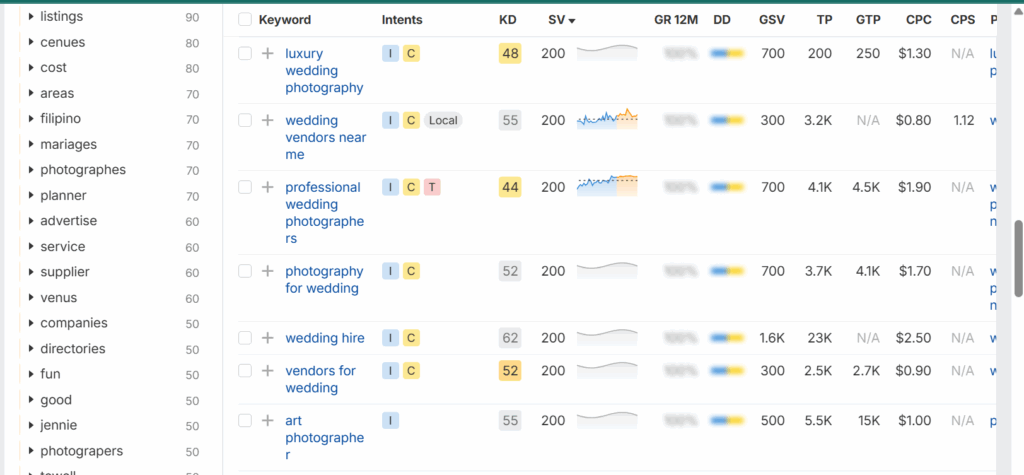
Follow this workflow for keyword discovery:
- Broad terms: Start with “wedding photographer” to see high-level trends.
- Geographic modifiers: Narrow down by adding your city or region (e.g., “Austin wedding photographer”).
- Style modifiers: Add descriptors like “candid,” “fine art,” or “luxury” to attract specific client personas.
Example terms you can use right away
- [City] wedding photography packages
- Best wedding venues in [City] for photography
- Black and white wedding photographer [Region]
Prioritize Long-tail keywords
While “wedding photographer” is highly competitive, long-tail phrases like “dark and moody wedding photographer in the Pacific Northwest” are easier to rank for and yield higher conversion rates. These searchers have a specific vision and are often further along in the booking process.
Pro Tip: Use Google Search Console to monitor which specific phrases are already driving “impressions” to your site, then optimize those pages to improve their click-through rate.
3 essential on-page SEO tips
Use title tags, meta descriptions, and headings effectively
Your Title Tag (under 60 characters) and Meta Description (under 160 characters) are your “billboard” in search results. Ensure they include your primary wedding photographer seo keywords. Use H1 tags for your main page title and H2/H3 tags to break up content, making it readable for both users and bots.
Optimize image file names and alt text
Search engines cannot “see” images; they read the data behind them. Replace generic filenames like “IMG_1234.jpg” with descriptive, keyword-rich names like “industrial-warehouse-wedding-los-angeles.jpg.” Use Alt Text to describe the scene naturally, providing context that helps your work appear in Google Image searches.
Use internal links to guide visitors
Guide your users (and Google’s crawlers) by linking between related content. If you mention a specific venue in a blog post, link to your “Venues” landing page. This distributes “link juice” across your site and keeps potential clients engaged with your portfolio longer.
Picture-based SEO strategy for wedding photographers
Images are the lifeblood of your business. To maximize their SEO value, they must be more than just visual assets—they must be data-rich entry points for new traffic.
Optimize file names with target keywords
Rename every image to include your target location and style. This simple step is one of the most overlooked aspects of seo for wedding photographer success.
Write descriptive alt text
Alt text is essential for accessibility and image ranking. Example: “Bride in lace gown walking through a vineyard at sunset in Napa Valley.” This tells Google exactly what the image represents and where it was taken.
Keep EXIF data for local SEO signals
Maintaining EXIF data—specifically GPS coordinates—acts as a “hidden” local SEO signal. It confirms to Google that you actually perform work in the locations you claim to serve.
Create keyword-focused galleries
Instead of one massive “Portfolio” page, create niche galleries like “Mountain Elopements” or “Estate Weddings.” This allows each page to target specific, high-intent keywords.
Share optimized images for high-quality backlinks
When your images are featured on wedding blogs or vendor sites, ensure they link back to your specific gallery. These wedding photographer backlinks from high-authority niche sites are gold for your search rankings.
Maximizing your SEO efforts with local SEO
Local SEO is what places you in the “Map Pack”—the most valuable real estate on the search results page. It ensures that when a local couple searches for a photographer, your business appears at the top.
Set up and optimize your Google Business Profile
Your Google Business Profile (GBP) is your most important local asset. Ensure your Name, Address, and Phone number (NAP) are accurate. Consistency across the web is a major ranking factor.
- Categories: Select “Wedding Photographer” as your primary category.
- Reviews: Actively solicit reviews. High ratings with keyword-rich text from clients significantly boost rankings.
- Posts: Use the “Update” feature to share recent wedding highlights and local news.
Get listed in local directories and wedding vendor sites
Citations on sites like The Knot, WeddingWire, and your local Chamber of Commerce build the “web of trust” Google looks for. Ensure your NAP data is identical on every platform to avoid confusing search algorithms.
Combine local SEO with your content strategy
Create content that highlights your local expertise. A post titled “10 Best Light-Filled Venues in [City]” provides value to couples and ranks for location-specific searches.
Real-World Example: The “Venue-Specific” Authority
Problem: A Dallas photographer was struggling to rank for broad city terms against 500+ competitors.
Solution: They created dedicated “Venue Guide” pages for the top 5 local luxury venues, featuring their own photos and tips for each location.
Result: Within 4 months, they ranked #1 for those specific venue names, resulting in a 40% increase in inquiries from couples who had already booked those locations.
Earn backlinks from other wedding photographers and vendors
Why industry-relevant wedding photographer backlinks are vital
A backlink is a digital endorsement. A link from a high-authority venue or a popular bridal blog carries significantly more weight than a link from a generic directory. Link building for wedding photographers focuses on these high-impact, niche-relevant connections.
Use guest posts to showcase your expertise
Contribute expert advice to local bridal magazines or vendor blogs. This builds authority and earns you a valuable backlink from an industry peer.
Interactive Asset: Vendor Outreach Email Script
Use this script to request a backlink after sharing photos with a vendor:
“Hi [Vendor Name], I just finished editing the [Client Name] wedding and your [flowers/decor/planning] looked incredible! I’ve uploaded the gallery here: [Link]. Feel free to use these for your site/socials—all I ask is that you include a link to my site ([Your URL]) if you post them on your blog. Looking forward to working together again!”
Collaborate on styled shoots for cross-promotion
Styled shoots are wedding photographer link building machines. When the shoot is published, every participating vendor (florist, venue, MUA) links to one another, creating a powerful network of industry backlinks.
Partner with vendors for mutual benefits
Offer to provide high-quality “venue photos” for a site’s home page in exchange for a credit link. This provides the vendor with professional assets and provides you with a permanent, high-authority backlink.
Network with other wedding photographers
Referral networks are excellent for SEO. Create a “Recommended Peers” section on your site to link to photographers in other regions or price points; they will often reciprocate, building a natural link profile.
Real Results: Wedding Photographer SEO Case Studies
Shane — $42,000 Extra Revenue From SEO: A wedding photographer went from 1 inquiry per week to 5 per week within 2 months of implementing SEO. He went from 12 booked weddings to completing 46 that year — generating an estimated $42,000 in additional revenue from organic search alone [Brendan Hufford, 2025].
Belinda Philleo — 10x Organic Traffic: A Southern California wedding photographer saw organic search traffic increase by 10x through website content optimization and strategic backlink building. She focused on getting featured on related photography websites and business directories [Wedding Maps, 2025].
Kiss in Paris — Top Paris Photographer Rankings: Novalab SEO Agency transformed this photography business into a top-performing Paris photographer through increased search visibility and qualified organic traffic that converted into consistent bookings [Novalab, 2025].
Becky Kerr Photography — Results in 3 Months: After implementing onsite SEO improvements and an ongoing content marketing campaign, this photographer saw measurable improvements in both traffic and client enquiries within 3 months [Edge of the Web, 2025].
Conclusion + next steps
Wedding photographer SEO is not a one-time task but a continuous process of building authority and relevance. By combining on-page optimization, image SEO, and proactive wedding photographer link building, you create a sustainable lead generation engine.
Your immediate action plan:
- Audit your top 5 images and rename them with descriptive keywords.
- Update your Google Business Profile with 3 new portfolio shots.
- Reach out to one venue you worked at last month to share your gallery and request a link.
For more, see our photographer link building guide, pricing guide, and beginner checklist.
Disclosure
SERPreach provides niche edit and guest posting services for photography businesses.
References
- BrightLocal. (2025). Local Consumer Review Survey. brightlocal.com
- Brendan Hufford. (2025). Wedding Photographer SEO Case Study: $42,000 Extra. brendanhufford.com
- Wedding Maps. (2025). How to 10x SEO Traffic. weddingmaps.com
- Novalab. (2025). Kiss in Paris SEO Case Study. thenovalab.com
- Edge of the Web. (2025). Becky Kerr Photography SEO Case Study. edgeoftheweb.co.uk

