
By Sabahat Ali – Link building expert since 2009 – 668+ clients served
KEY STATISTICS
- 73% of plastic surgery patients research procedures online before booking [First Page Sage]
- SEO delivers the lowest patient acquisition cost across all surgical categories [First Page Sage, 58 clinics analyzed]
- 94% of consumers trust positive reviews; 4+ star ratings capture 29% more clicks [Plastic SEO]
- AI Overviews dominate 67% of healthcare questions, projected 80% by late 2025 [Plastic SEO]
- Ranking improvements in 3-4 months; full results in 6-12 months [Ranking Studios]
Plastic surgery is a high-stakes industry where digital authority translates directly into patient trust and qualified leads. Effective seo for plastic surgeons and link building for plastic surgeons are no longer optional—they are the primary drivers of practice growth. This guide provides a focused, actionable framework to dominate search engine results pages (SERPs).
For time-consuming tasks like plastic surgeons link building, focus on quality over quantity. I recommend prioritizing niche edits and guest post links from authoritative, medical-grade domains.
TL;DR: 10-step link building and SEO for plastic surgeons
What is link building for plastic surgeons?
Link building for plastic surgeons is the strategic acquisition of plastic surgeons backlinks from authoritative health, medical, and local websites. By securing links from trusted sources like medical journals or aesthetic blogs, a practice increases its domain authority, directly improving search rankings and driving high-intent patient inquiries.
| Step | Focus area for plastic surgeon SEO |
|---|---|
| 1 | Audit your plastic surgery practice’s website |
| 2 | Research relevant keywords |
| 3 | Target long tail keywords |
| 4 | Optimize on-page SEO elements |
| 5 | Set up a local SEO foundation |
| 6 | Build a clear SEO strategy |
| 7 | Create content marketing assets |
| 8 | Implement outreach-based link building |
| 9 | Use directory and citation link building |
| 10 | Monitor performance & refine marketing strategies |
Step 1: Audit your plastic surgery practice’s website
Technical health is the foundation of seo for plastic surgeons. If your site is slow or broken, even the best backlinks won’t convert visitors.
Test your site speed and mobile responsiveness
Use Google PageSpeed Insights. Mobile-first indexing is critical; patients often research procedures on smartphones. Aim for a load time under 3 seconds to minimize bounce rates.
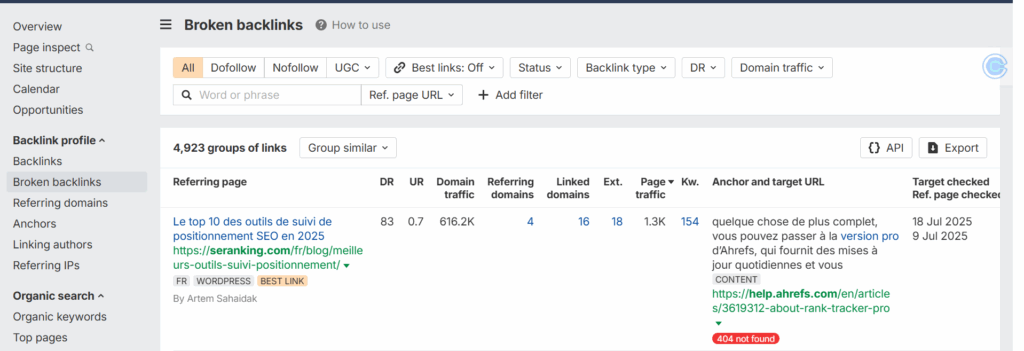
Fix broken links and outdated content
Crawl your site with tools like Screaming Frog. Fix 404 errors and update pages referencing retired surgeons or discontinued technologies to maintain professional credibility.
Make every service page conversion-ready
Ensure every page has a distinct Call to Action (CTA). Whether it’s “Book a Consultation” or “View Before-and-After Gallery,” make it visible. Conversion optimization is as vital as traffic generation.
Step 2: Research relevant keywords
Keyword research identifies how your patients describe their needs. Mastering plastic surgeons seo requires balancing technical medical terms with common phrasing.
Use keyword research tools to find opportunities
Leverage Google Keyword Planner or Ahrefs. Don’t just target high-volume terms; look for keywords with “commercial intent” where users are looking for a provider, not just information.
Identify what your ideal patient is searching for
Patients search for solutions, not just procedures. “Rhinoplasty cost” and “best surgeon for facelift in [City]” are high-value targets. Map these to your core service pages.
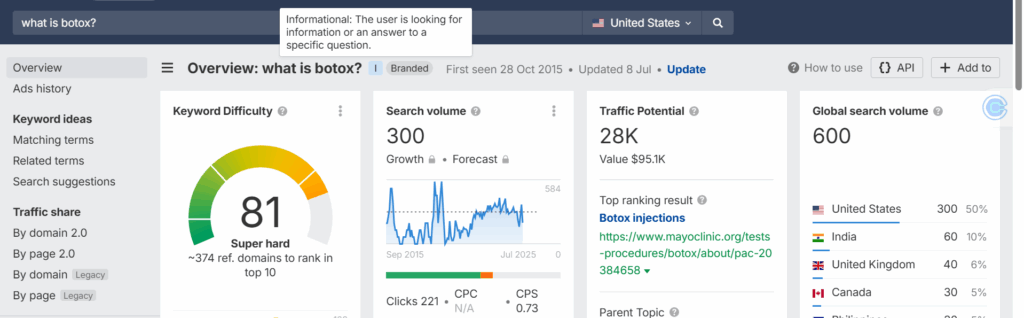
Match your keywords to search intent
Distinguish between informational (e.g., “how long does liposuction take”) and transactional intent (e.g., “liposuction surgeon near me”). Your content should address both to capture the full patient journey.
Step 3: Target long tail keywords
Long-tail keywords are specific phrases with lower competition and higher conversion rates. They are essential for a nuanced seo for plastic surgeons strategy.
Focus on location-based phrases for your plastic surgery SEO
Avoid competing for broad terms like “breast augmentation.” Instead, optimize for “revision breast augmentation in [City]” or “non-surgical nose job [City].” This targets users ready to take action.
Use tools to discover long tail variations
Use AnswerThePublic to find questions patients are asking. “Does insurance cover tummy tuck for back pain?” is a specific question that can drive targeted traffic to your blog.
Add them naturally across your content
Integrate these phrases into FAQs, photo captions, and subheadings. This helps Google understand the depth of your expertise across specific niche procedures.
Step 4: Optimize on-page SEO elements
On-page optimization signals your site’s relevance to search engines and improves the user experience for prospective patients.
Write compelling meta descriptions for every page
The meta description is your SERP sales pitch. Include your primary keyword and a benefit-driven CTA within 160 characters. Example: “Achieve natural results with board-certified breast augmentation in Houston. View our gallery and book your consultation today.”
Use keywords naturally in key areas
Ensure your H1 matches the page’s primary intent. Use plastic surgeons backlinks as anchor text for internal links, and ensure all images have descriptive ALT text for accessibility and SEO.
Link internally to related services and resources
Internal linking helps Google crawl your site. Link your “Mommy Makeover” page to your “Liposuction” and “Tummy Tuck” pages. This keeps users on your site longer and passes authority between pages.
Step 5: Set up a local SEO foundation
For plastic surgeons, local visibility is paramount. Most patients will not travel across the country for common procedures, making local dominance essential.
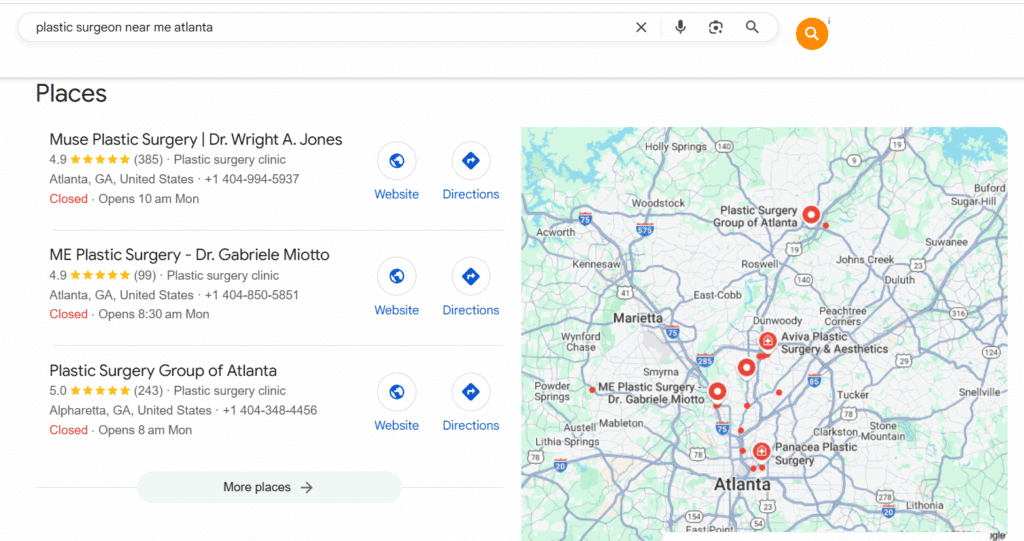
Claim and optimize your Google Business Profile
Your GBP is often the first thing patients see. Complete every section, including “Services,” “Products,” and “FAQs.” Use plastic surgeons seo-friendly descriptions of your clinic’s specialties.
Keep your NAP information consistent everywhere
Name, Address, and Phone number must be identical across all platforms. Discrepancies in NAP data damage your local ranking signals and confuse potential patients.
Collect reviews, post updates, and upload photos
High-quality reviews are a major ranking factor. Implement a system to solicit reviews from happy patients. Regularly post “Before and After” updates directly to your Google profile to show activity.
Step 6: Build a clear SEO strategy
A scattergun approach rarely works. You need a documented strategy to measure ROI on your link building for plastic surgeons efforts.
Set short-term and long-term keyword goals
Focus on “low-hanging fruit” like ranking for specific procedure+city terms in the short term. Long-term, aim for authority on broad health and wellness topics that attract top-of-funnel traffic.
Create realistic content and update the schedule
Consistency beats intensity. Publishing one high-quality, medically-reviewed article every two weeks is more effective than a burst of low-quality posts followed by months of silence.
Define who owns what if you’re not solo
Assign clear responsibility for content creation, technical maintenance, and plastic surgeons backlinks acquisition. Use a project management tool to track these tasks and ensure deadlines are met.
Step 7: Create content marketing assets
High-value content is the fuel for link building. If your content isn’t useful, other sites won’t link to it.
Write blog posts that answer common patient questions
Address concerns regarding recovery times, safety protocols, and realistic expectations. This satisfies Google’s EE-A-T (Experience, Expertise, Authoritativeness, Trustworthiness) requirements.
Use visual content to build credibility
Before-and-after galleries are your strongest conversion tool. Ensure these images are high-resolution and optimized for speed. Video content explaining a procedure can significantly increase “time on page.”
Repurpose valuable content for email and social media
A comprehensive blog post on “Recovery After Rhinoplasty” can be distilled into an email newsletter, a series of Instagram tips, and a short YouTube video. Maximize the reach of every asset you create.
Step 8: Implement outreach-based link building
Active outreach is the only way to secure the plastic surgeons backlinks that actually move the needle on your rankings.
Comparison of Link Building Strategies
| Strategy | Effort | Authority Level | Primary Benefit |
|---|---|---|---|
| Guest Posting | High | High | Control over anchor text & relevance |
| Niche Edits | Medium | High | Instant authority from aged content |
| Directories | Low | Low/Medium | Foundation for Local SEO |
| Influencer PR | High | Medium | Brand awareness & social signals |
Pitch guest posts to industry-relevant blogs
Contribute expert insights to beauty, health, and wellness websites. This positions you as an industry leader and earns you a high-quality backlink to your practice site.
Interactive Asset: Guest Post Outreach Script
Subject: Expert Contribution: [Topic Suggestion] for [Site Name]
Hi [Name], I’m [Your Name], a board-certified plastic surgeon at [Practice]. I’ve been following your coverage on [Topic], and I’d love to contribute a medically-reviewed piece on [New Specific Topic] to provide your readers with professional insights on safety and results. Would you be interested in a draft?
Collaborate with influencers or local partners
Partner with local dermatologists or luxury spas for cross-promotion. A link from a local partner is a powerful signal of local relevance to search engines.
Only accept links from credible, relevant sources
Quality over quantity is the golden rule of plastic surgeons link building. Avoid PBNs or “link farms.” One link from a site like RealSelf or a medical journal is worth a thousand spammy comments.
Step 9: Use directory and citation link building
Citations confirm your practice’s physical location and legitimacy, serving as a pillar for seo for plastic surgeons.
List your practice on reputable medical directories
Ensure you are present on Healthgrades, Vitals, RealSelf, and Zocdoc. These sites often rank on the first page of Google themselves, providing a secondary way for patients to find you.
Keep your business details 100% consistent
Audit your citations annually. Any change in phone number or location must be updated across all directories simultaneously to maintain SEO integrity.
Treat these profiles as local SEO boosters
Directories are more than just listings; they are trust signals. Complete profiles with high-quality photos and detailed service descriptions to maximize their impact.
Step 10: Monitor performance and refine marketing strategies
Data-driven adjustments ensure your plastic surgeons seo remains competitive as search algorithms evolve.
Case Study: 45% Increase in Consultations
Problem: A Miami-based clinic had high traffic but zero growth in bookings.
Action: We optimized their “Before & After” pages with long-tail keywords and secured 5 high-authority plastic surgeons backlinks from medical lifestyle blogs.
Result: Organic leads increased by 45% within four months, and “Rhinoplasty Miami” moved from page 3 to the top 3 spots.
Use tools to track traffic and rankings
Monitor Google Search Console for “Impressed” keywords and click-through rates. Use Google Analytics to track which traffic sources (organic, referral, social) lead to the most “Book Now” clicks.
Identify what drives real leads
Focus your budget on the keywords and content types that convert. If your blog posts on recovery are driving more calls than your procedure overviews, double down on recovery-focused content.
Improve or replace low-performing content
If a page’s ranking drops, refresh it with new data, better images, or updated medical guidelines. Seo for plastic surgeons is a continuous cycle of optimization.
By following this framework, your practice will build the digital authority necessary to attract more patients and dominate the local market.
For link building costs in the medical niche (premium pricing due to YMYL), see our pricing guide. Healthcare links cost 20-50% more than general business links. For ROI, use our calculator.
Disclosure
SERPreach works with medical practices on link building. We offer niche edits and guest posting including health-niche placements.
References
- First Page Sage. (2026). Plastic Surgery Lead Generation Statistics. 58 clinics analyzed. firstpagesage.com
- Plastic SEO. The Future of SEO for Plastic Surgeons. plasticseo.com
- Ranking Studios. (2026). Plastic Surgeon SEO Guide. rankingstudios.com

