
By Sabahat Ali – Link building expert since 2009 – 668+ clients served
KEY STATISTICS
- Financial advisor SEO ROI: up to 200% organic traffic growth in 6 months [Twenty Over Ten]
- FinTech link building case: 374% traffic increase + 65% revenue growth in 12 months [RhinoRank]
- Finance is a “high-cost niche” for link building: $500+ per quality link [Editorial.Link, 2025]
- 46% of all Google searches have local intent [BrightLocal, 2025]
- 80% of webmasters who respond to outreach demand payment [Our data, 100K+ emails]
Finance is a critical YMYL (Your Money, Your Life) sector where Google demands high levels of Expertise, Experience, Authoritativeness, and Trustworthiness (E-E-A-T). For firms today, SEO for financial advisors is the most sustainable way to build that trust and attract high-net-worth clients without the rising costs of paid advertising.
This guide provides a tactical framework for financial advisors SEO, covering everything from technical on-page adjustments to advanced link building for financial advisors.
Quick Summary
A successful SEO strategy for financial firms integrates high-intent keyword research, technical site optimization, and a robust backlink profile. By focusing on local visibility and authoritative content, advisors can transform their website into a lead-generation machine.
What you’ll get:
- High-intent keyword strategies for financial niches.
- Proven methods to earn financial advisors backlinks.
- Technical optimization steps to improve search visibility and user experience.
Why does SEO matter for financial advisors?
Featured Snippet: What is SEO for Financial Advisors?
SEO for financial advisors is the process of optimizing a firm’s digital presence to rank higher in search results for queries like “financial planning” or “fiduciary advisor.” It involves keyword optimization, local SEO, and link building for financial advisors to establish authority, build client trust, and drive organic lead generation.
Prospects vetting a financial professional almost always start with a Google search. If your firm isn’t visible, you lose the opportunity to compete. High rankings act as a “digital endorsement,” signaling to potential clients that your firm is a reputable authority in a high-stakes industry.
SEO for financial advisors bridges the gap between visibility and persuasion:
- On-page SEO: Factors you control, such as E-E-A-T focused content, page speed, and internal linking.
- Off-page SEO: External signals like financial advisors backlinks and brand mentions that validate your expertise.
Building a solid SEO strategy
A data-driven strategy ensures you aren’t just chasing traffic, but attracting the right intent. Because financial services are highly regulated, your strategy must balance SEO performance with compliance-ready messaging.
Real-World Case Study: Boutique Firm Growth
Problem: A Dallas-based wealth management firm had a professional site but zero organic leads.
Solution: We implemented a local financial advisors SEO campaign targeting “fiduciary retirement planners in Dallas” and launched a guest posting campaign on high-authority finance sites.
Result: Within 6 months, organic traffic increased by 140%, and the firm secured three high-net-worth clients directly from search results.
SEO strategy checklist for financial advisors
- Define Target Audience: Identify specific niches (e.g., tech executives, business owners).
- Intent Mapping: Focus on “bottom of funnel” terms like “fee-only financial advisor.”
- Technical Audit: Ensure mobile-friendliness and fast load times.
- Content Creation: Develop long-form guides that answer complex financial questions.
- Performance Tracking: Use Search Console to monitor keyword growth and conversions.
Keyword strategies that work for financial advisors
Effective financial advisors SEO requires moving beyond generic terms. You need to capture users at different stages of the decision-making process.
Keyword Strategy Comparison:
| Keyword Type | Example Query | Conversion Potential |
|---|---|---|
| Educational | “What is a fiduciary?” | Low (Awareness) |
| Local/Service | “Financial advisor in [City]” | High (Action) |
| Niche-Specific | “Retirement planning for doctors” | Very High (Targeted) |
Step 1: Know your audience
Mine your client meetings for “seed keywords.” Prospects often search for answers to the exact questions they ask you in person, such as:
- “How to minimize capital gains tax in 2025”
- “Best 401k rollover options”
- “Inheritance tax laws in [State]”
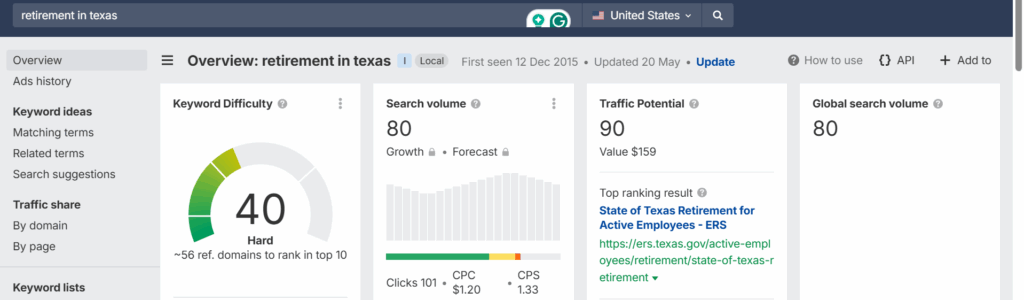
Step 2: Use keyword research tools
Professional tools help validate search volume and competition levels for financial advisors link building opportunities.
- Google Autocomplete: Find the long-tail questions users are asking.

- Ahrefs/Semrush: Analyze the backlink profiles of competitors ranking for your target keywords.
Step 3: Map intent + cluster keywords
Organize your content into clusters. This demonstrates deep topical authority to Google, which is vital for YMYL sites.
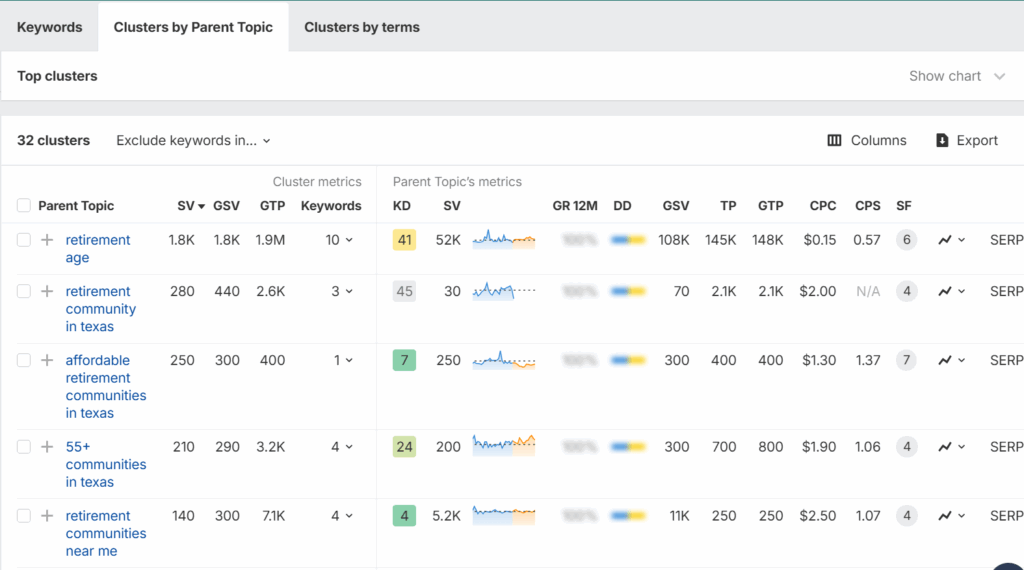
Example keyword clusters
- Estate Planning: Wills vs. trusts, power of attorney, estate tax strategy.
- Investment Management: Index funds vs. active management, risk tolerance, ESG investing.
- Local Search: Best financial advisor near me, wealth management in [City].
On-page SEO for financial planning websites
On-page optimization ensures search engines can crawl, index, and understand your expertise. Each service page should be a comprehensive resource for its target keyword.
Start with your core pages
Optimize your primary service pages (e.g., Wealth Management, Tax Planning) by placing the main keyword in:
- The Meta Title and Meta Description.
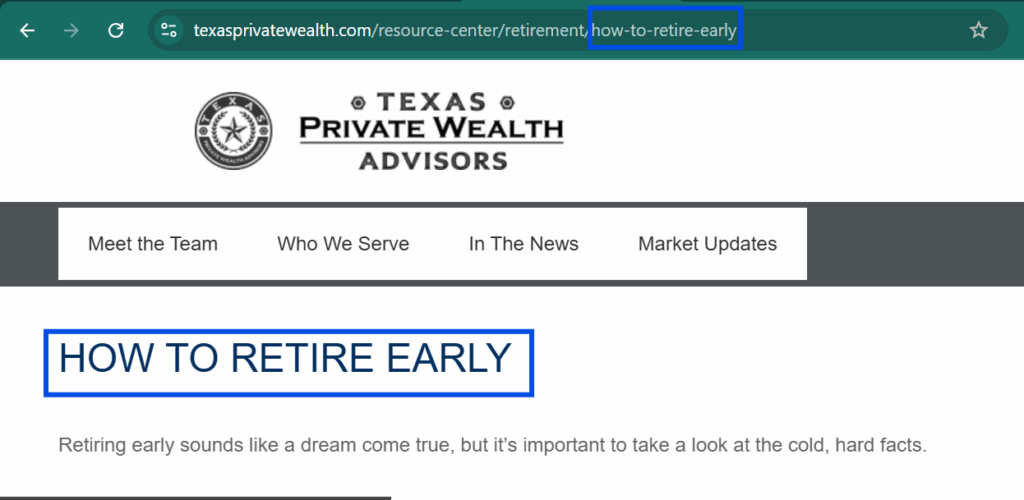
- The H1 Header.
- The first paragraph (introductory text).
- The URL slug (e.g., /austin-financial-advisor/).
Add internal links
Internal linking distributes “link equity” across your site. Link your blog posts to your service pages to funnel visitors toward your contact form.
Don’t forget image SEO
Ensure all images use descriptive alt text that includes keywords like “financial planning consultation” to improve accessibility and image search rankings.
Improve the technical SEO
- Site Speed: Use WebP images and minimize heavy scripts.
- Mobile Responsiveness: Most local searches happen on mobile devices.
- HTTPS: Security is non-negotiable for finance websites.
Off-page SEO and high-quality backlinks
Financial advisors backlinks are the primary ranking factor for competitive terms. A backlink serves as a “vote of confidence” from one site to another.
What is a backlink?
A backlink is an external link from another website to yours. In link building for financial advisors, links from authoritative financial news sites or local chambers of commerce carry the highest weight.
How financial advisors can build high-quality backlinks
- Guest Posting: Contribute expert insights to reputable finance publications.
- Industry Directories: Secure listings in specialized directories like NAPFA, FEEA, or the CFP Board.
- Local SEO Boosters: Sponsor local events or join the Chamber of Commerce for high-quality geo-relevant links.
- Linkable Assets: Publish original data, market reports, or complex calculators that other sites will want to link to.
- Strategic Partnerships: Exchange mentions with complementary professionals, such as CPAs or Estate Attorneys.
Interactive Asset: Link Building Outreach Script
Copy and customize this script to earn financial advisors backlinks from local partners:
Subject: Potential Resource for [Business Name] Clients
Hi [Name], I’m a financial advisor at [Your Firm]. I’ve been sharing your [Tax/Legal] resources with my clients lately and they’ve found them incredibly helpful. I recently wrote a deep-dive guide on [Topic] that I think your readers would find valuable as well. Would you be open to a quick collaboration or featuring the resource on your site? Best, [Your Name].
Local SEO: Get found in your area
For most firms, seo for financial advisors is local. If you don’t appear in the “Map Pack,” you are missing out on high-intent local traffic.
What is the map pack?
The Google Map Pack is the section of search results that displays the top three local business listings alongside a map.
Step 1: Optimize your Google Business Profile
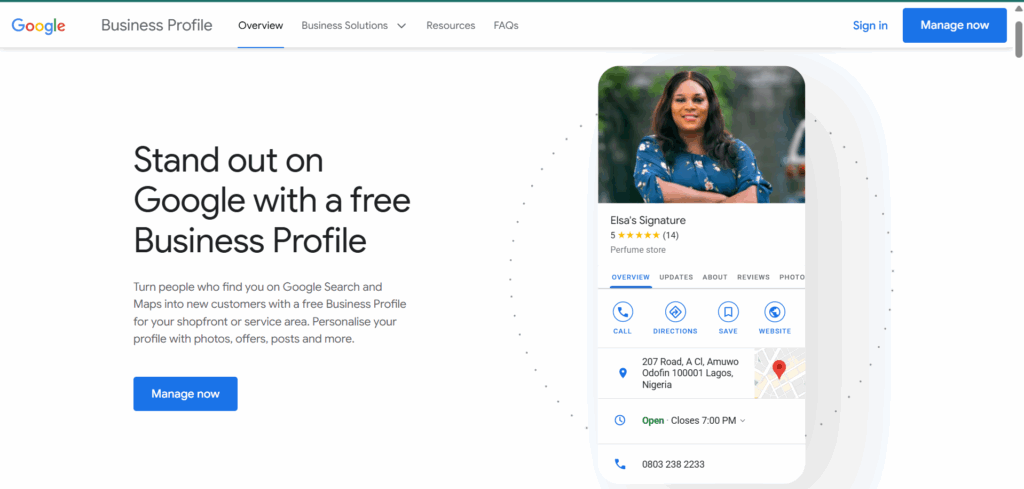
- Verify your profile at google.com/business.
- Ensure your Business Name, Address, and Phone (NAP) are identical across the web.
- Add specific services like “Retirement Income Planning” to your profile.
Step 2: Get local citations
List your firm on Yelp, Bing Places, and financial-specific directories like FeeOnlyNetwork to build a consistent digital footprint.
Step 3: Ask for reviews
Client reviews are a massive ranking factor. Implement a process to ask satisfied clients for a Google review, as this directly influences Map Pack rankings.
Step 4: Use Geo-specific keywords
Naturally weave phrases like “Investment management in [City]” into your website content and meta data.
Real Results: Financial Advisor SEO Case Studies
Dream Financial Planning — 200% Traffic Growth: This financial planning firm grew organic traffic from under 400 visitors to 1,230 per month within 6 months through targeted content creation and on-page optimization [Twenty Over Ten, 2024].
AdvancePoint Capital — 4x Leads in 4 Months: A financial services company saw leads from organic search more than quadruple in four months. Total organic keyword rankings grew by 200% between March and October [The HOTH, 2025].
FinTech Company — 374% Traffic, 65% Revenue Growth: A FinTech client experienced 374% organic traffic increase over 12 months through a comprehensive link building strategy combining contextual links and guest posts on credible websites. This also drove 65% revenue growth year-over-year [RhinoRank, 2025].
The common thread: financial services SEO works when you combine quality content targeting client questions with consistent link building over 6-12 months.
Conclusion + next steps
Success in financial advisors seo isn’t about gaming the system; it’s about providing the best possible answers to your prospects’ questions and proving your authority through financial advisors link building.
To recap your growth plan:
- Target high-intent, niche-specific keywords.
- Optimize your technical foundation and on-page E-E-A-T signals.
- Aggressively pursue link building for financial advisors.
- Dominate your local market through Google Business Profile optimization.
Ready to scale your organic growth? If you want to accelerate your results, explore SERPReach’s link building services. We specialize in securing the high-authority financial advisors backlinks that move the needle for firms in competitive markets.
For general link building strategy, see our pricing guide, beginner checklist, and backlinks needed to rank analysis.
Disclosure
SERPreach provides niche edit and guest posting services for financial services businesses.
References
- Editorial.Link. (2025). Link Building Survey 2025. editorial.link
- BrightLocal. (2025). Local Consumer Review Survey. brightlocal.com
- Twenty Over Ten. (2024). SEO Case Study: Dream Financial Planning. twentyoverten.com
- The HOTH. (2025). Finance SEO Case Study: 50% Traffic Growth. thehoth.com
- RhinoRank. (2025). FinTech Link Building Case Study: 374% Traffic Increase. rhinorank.io

